Managing a commercial property in Daytona Beach means keeping up with constantly changing rules. If your parking lot striping in Daytona Beach, Florida, hasn't been updated since the 2023 Florida Building Code changes, you're likely at risk of fines or lawsuits. At Florida Sealcoating, we help property managers avoid these headaches every day by ensuring their lots meet strict state and federal standards.
Florida regulations are actually stricter than federal ADA guidelines in several key areas. Under the Florida Building Code, 8th Edition, you need specific ratios of accessible spaces based on your total parking spots [1]. For example, a lot with 26-50 spaces requires at least two accessible spots. If you manage a larger retail center near the Speedway with 201-300 spaces, you need seven accessible spots.
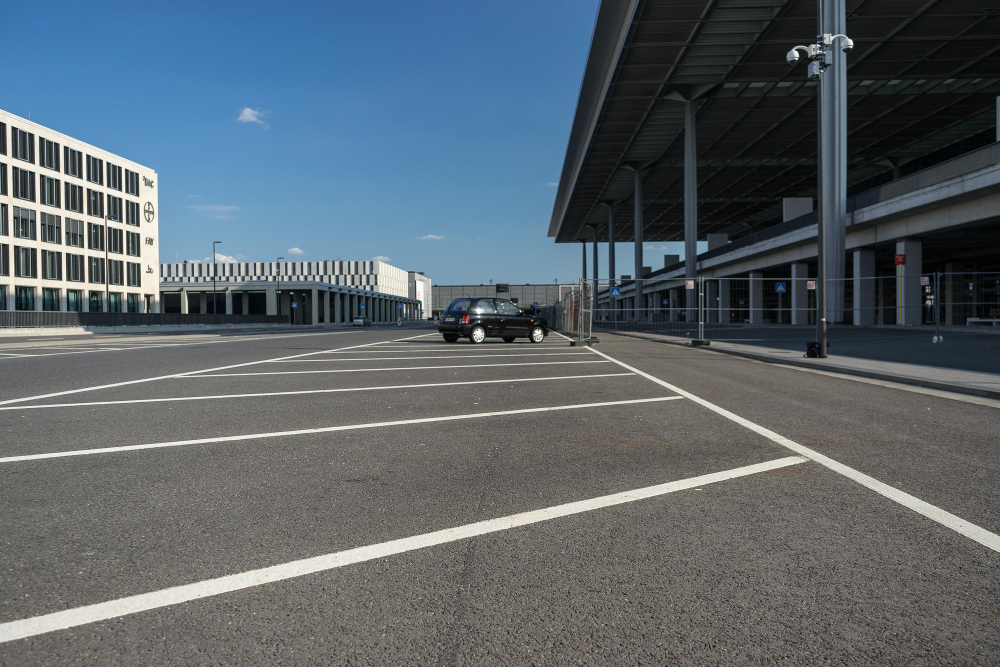
Beyond the number of spaces, the physical dimensions are non-negotiable. Standard accessible spaces must be at least 12 feet wide with a 5-foot access aisle. We often see older lots in Volusia County that still use the outdated 11-foot width. If an inspector measures your lot today, that missing foot could cost you thousands in fines.
While the core laws haven't drastically shifted overnight, enforcement has tightened regarding "path of travel" and cross-slope requirements in Daytona Beach. Inspectors now strictly enforce the 2% maximum slope rule in all directions for accessible spaces. If your lot has settled due to our local sandy soil—which is common beachside—you might be non-compliant without realizing it.
Another major focus for 2026 is the visibility of your "Traffic Blue" paint. Florida Statute 553.5041 requires a specific color standard. Due to our intense Florida sun and salt air, this blue paint fades faster here than in other parts of the country. If the contrast ratio drops below 70%, it's considered a violation.
Start by measuring the width of your accessible spaces; they must meet the 12-foot requirement alongside a 5-foot aisle. Grab a tape measure and check these critical points immediately:
In our inspections across Daytona, the most common failure we see isn't a lack of spaces, but the slope. If a wheelchair user risks rolling backward because the grade is too steep (over 1:48 ratio), you have a liability issue.
Ignoring ADA violations costs far more than re-striping. In Florida, businesses can face fines up to $75,000 for a first violation. That doesn't include legal fees if a "tester" files a lawsuit against your property, which averages $10,000 to settle out of court.
We've seen it happen to well-meaning business owners on International Speedway Blvd. They delayed re-striping to save budget, only to be hit with a lawsuit that cost five times the price of a striping job. Reputational damage is harder to quantify, but in a tight-knit community like ours, word travels fast if a business isn't welcoming to everyone.
Fresh parking lot striping in Daytona Beach, Florida, yields an ROI of roughly 300% when you consider curb appeal and liability reduction. It signals to the 26% of adults in Florida with a disability that your business welcomes them.
Beyond compliance, clear striping improves traffic flow and safety. When we apply fresh thermoplastic paint, it reflects headlights better at night. This reduces accidents and keeps pedestrians safe, which lowers your overall insurance risk profile. Plus, a well-maintained lot tells potential tenants and customers that you care about the details.
We aren't just guys with a truck; we understand the specific asphalt challenges near the Halifax River and beachside. We use FDOT-approved paint that withstands our intense UV rays for 3-5 years, not the cheap stuff that flakes off in six months.
Our technicians typically find that generic paving companies miss the specific Florida signage requirements. We know the local codes inside and out. When we inspect a home or business in Ormond Beach or Port Orange, we check for issues that out-of-town contractors miss, like drainage impacting the slope of your accessible spaces.
We recently helped a medical office near Halifax Health update their 50-space lot. They had incorrect signage height and faded blue lines that were barely visible. Within one day, we brought them to 100% compliance for under $1,800.
Another client, a retail strip on Nova Road, was worried about the disruption to their tenants. We scheduled our crew to work overnight. By 7:00 AM, the lot featured crisp, compliant lines and new signs, with zero impact on their business hours. You can see the difference proper spacing makes—customers stopped double-parking immediately.
Don't try to interpret the 700-page code book yourself. Start by calling a licensed contractor to perform a site audit. You can also reference the U.S. Department of Justice's ADA Update [2] for federal baselines, but remember that Florida's code is the one you must pass.
It's smart to schedule a striping assessment every 12 to 18 months. Given our weather, paint degradation happens faster here. Keeping a log of your maintenance shows "good faith" effort, which can be a lifesaver if a complaint is ever filed against your property.
ADA compliance isn't just about avoiding fines; it's about making your business accessible to our entire community. Don't wait for a complaint letter to arrive.
If you're not sure if your lot meets the 2026 standards for parking lot striping in Daytona Beach, Florida, let us take a look. Contact Florida Sealcoating today for a free compliance assessment. We'll give you a clear, honest report on exactly what needs to be done to keep your property safe and legal.
[1] Florida Building Code - Accessibility
[2] U.S. Department of Justice ADA Update
Get a free, no-obligation estimate for your asphalt project. Our team is ready to help protect and enhance your property.
(407) 942-3681