If you’re planning a project involving paving in Sanford, Florida, you’re likely already staring at a stack of paperwork regarding Seminole County’s land development codes. Expanding a business or repaving a parking lot here isn't just about laying down fresh blacktop; it’s about balancing functional parking with strict aesthetic and environmental standards. One of the biggest hurdles commercial property owners face is the "10% internal landscape" requirement.
We’ve seen plenty of business owners get frustrated by these codes, but they exist to keep our area from becoming an endless heat island. The good news is that smart asphalt design doesn't fight these rules—it helps you meet them. Here is a practical look at how to navigate these requirements, what it costs, and how to get your parking lot approved without a headache.
In Seminole County, the Land Development Code (specifically Chapter 30, Part 64) generally requires that at least 10% of the interior of a vehicle use area (parking lot) must be landscaped. This doesn't mean just planting grass around the perimeter. The county wants "internal" green space—islands and peninsulas inside the paved area—to break up the visual monotony and reduce heat.
For a standard commercial lot, this means for every 10 parking spaces, you usually need a terminal island. We often see plans get rejected because the owner maximized parking spaces but forgot to calculate that 10% interior green requirement. If you have a 10,000-square-foot parking area, 1,000 square feet of that interior space must be dedicated to greenery.
This matters because code enforcement in Sanford is strict about heat island mitigation. A massive, unbroken slab of black asphalt absorbs Florida’s solar radiation, raising temperatures in our downtown and commercial districts. The 10% rule forces cooling breaks in that pavement.
Strategic paving layout uses curbing and island placement to hit that 10% target without sacrificing necessary customer parking. By using compact parking stalls (allowed for a percentage of spots in Sanford) and angled parking, we can often carve out the required square footage for landscape islands without reducing your total car count.
Terminal islands are the green spaces at the end of a parking row. They are the easiest way to rack up your percentage. When we layout a job site, we ensure these islands are at least 10 feet wide (a common requirement to protect tree roots). If you pave too close to where a Live Oak or Sabal Palm will go, the roots will eventually buckle your new asphalt.
You can also use divider strips—long runs of green space between facing rows of parking. While these eat up more real estate, they are excellent for stormwater management. In our experience working near the St. Johns River basin, drainage is everything. A divider strip can double as a swale, collecting runoff before it hits the catch basin.
Permeable asphalt allows water to drain through the surface rather than running off, which can sometimes reduce the size of required retention ponds, freeing up land for the required 10% landscaping. While permeable pavement itself isn't "greenery," it changes your site's impervious surface calculations.
Standard asphalt is impervious. When it rains in Sanford—especially during those 2 PM summer downpours—that water has to go somewhere. Usually, it goes into a massive retention pond that takes up valuable buildable land. By using porous asphalt, you store water underneath the parking lot in a stone recharge bed.
This is a smart trade-off. We’ve seen property owners reclaim 15-20% of their property that was designated for a retention pond and use that space for the required landscape buffers and extra parking instead. It costs more upfront (roughly 15-20% more than standard asphalt due to the specialized stone base), but the land usage gains often pay for it.
Check out more on the benefits of permeable surfaces here [2].
In Sanford, commercial asphalt paving generally costs between $3.50 and $5.50 per square foot for resurfacing (overlay) and $5.00 to $8.00 per square foot for new installation (including base work). These prices fluctuate based on oil prices and the distance to the asphalt plant, but this is a solid baseline for your budget.
In Sanford, we have specific soil conditions. Areas closer to Lake Monroe or the marina often have high water tables or sandy, shifting soil. This might require "undercutting"—digging deeper to remove bad soil and replacing it with stable fill. That can add $1,000 to $5,000 to a medium-sized project depending on the severity.
For an average commercial parking lot (20-50 spaces), the actual paving work takes 2-3 days, but the permitting and inspection process in Seminole County can take 3-6 weeks. We always tell property owners: don't schedule your grand opening for the day after we pour.
If you run a 24/7 business or a busy retail spot on US 17-92, we can phase the project. We’ll pave half the lot while you use the other half, then switch. This adds about 1-2 days to the total timeline but keeps your doors open.
A fresh asphalt parking lot typically offers an ROI of around 5% to 10% in immediate property value, but the real financial gain comes from liability reduction and lease rates. Tenants pay more for properties that look well-maintained, and insurance companies look favorably on lots without trip hazards.
If you own a plaza near the Seminole Towne Center, you know competition is stiff. A black, crisp parking lot with bright yellow striping signals to potential tenants that the building is managed well. We’ve seen landlords justify lease rate increases of $1-$2 per square foot simply by revitalizing the exterior, starting with the parking lot.
Trip and fall lawsuits are common in Florida. A pothole or a heave caused by a tree root in a landscape island is a lawsuit waiting to happen. Resurfacing eliminates these hazards. ADA compliance is also massive. If your handicap spots don't meet current code (slope, signage, van accessibility), you face fines starting at thousands of dollars. New paving fixes these grade issues.
The biggest mistake we see is planting the wrong trees in those required 10% landscape islands. Property owners love Live Oaks because they are native and shady, but their roots are asphalt destroyers.
When you plant a large aggressive root tree in a 10x10 island, those roots will hit the compacted road base under your asphalt within 3-5 years. They will lift the pavement, creating "volcanoes" that crack your lot and trip customers.
The Fix: Install root barriers when you put in the trees. These are heavy plastic shields buried vertically that force roots down instead of out. It adds a small cost upfront but saves you a $5,000 patch repair five years later.
Sanford is flat. If your paving contractor doesn't shoot the grades correctly (using a laser level), you will end up with "birdbaths"—puddles that sit on the asphalt. Standing water dissolves the oils in asphalt, causing it to unravel. We ensure a minimum 1% slope to keep water moving toward those catch basins.
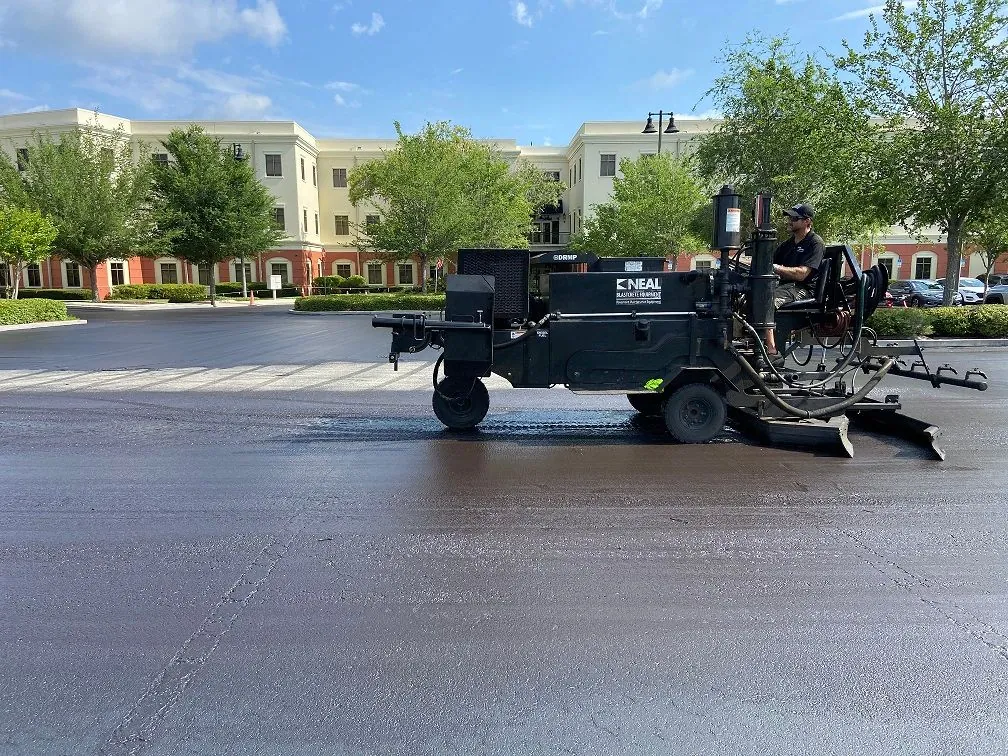
Florida Sealcoating has handled paving projects from the historic brick streets of downtown Sanford out to the newer developments in Heathrow. We understand the specific soil profiles of Seminole County and the strict requirements of local inspectors.
We aren't just guys with a truck; we are a full-service paving operation. We recently helped a medical office near the Central Florida Regional Hospital reconfigure their lot to add 15 spaces while bringing their landscape islands up to code. We handled the permitting, the root barriers, and the striping.
Our team knows that in Florida, you have to pave around the weather. We monitor the radar for those afternoon storms to ensure we never lay asphalt when the ground is wet, which guarantees the bond between layers holds up for years.
Don't let Seminole County’s landscape codes stall your business expansion. With the right design and the right paving team, you can boost your curb appeal and meet regulations seamlessly.
Contact Florida Sealcoating today for a free estimate. We’ll walk your property, check your compliance, and give you a clear price to get the job done right.
[1] Seminole County Land Development Code
[2] Evaluating the potential benefits of permeable pavement
Get a free, no-obligation estimate for your asphalt project. Our team is ready to help protect and enhance your property.
(407) 942-3681