.jpg)
Sealcoating in Orlando, Florida is the single most effective way to protect your pavement from our brutal 95-degree summer days. If you've lived in Central Florida for more than a year, you know the sun here doesn't just burn skin; it destroys building materials. Asphalt driveways are particularly vulnerable. Without protection, the combination of intense UV radiation and daily afternoon thunderstorms can double the rate at which your driveway cracks and deteriorates.
At Florida Sealcoating, we see the damage firsthand. A driveway that should last 20 years might fail in less than 10 if it's left exposed to the elements. The black surface of asphalt absorbs heat aggressively, often reaching temperatures 30 to 40 degrees higher than the air temperature. When you add heavy rains that wash away loose aggregate, you have a recipe for expensive repairs.
We're here to explain exactly why our local weather is so tough on pavement and how a professional sealcoat application saves you money.
In Orlando, asphalt temperatures can exceed 140°F when the air temperature hits 95°F. This extreme heat causes the liquid asphalt binder—the "glue" that holds the rocks and sand together—to oxidize and become brittle. Once that binder dries out, the aggregate loosens, the color turns a distinct shade of gray, and the flexibility of the pavement vanishes.
This loss of flexibility is the main problem. Asphalt needs to flex to handle the weight of your car. When it becomes brittle from heat oxidation, it cracks under pressure instead of bending. We see this constantly in neighborhoods like Dr. Phillips and Winter Park, where older driveways that haven't been sealed start looking like alligator skin.
It's not just the high heat; it's the fluctuation. Florida materials go through a daily cycle of thermal expansion and contraction.
This constant movement creates stress fractures. If you don't have a sealcoat layer to shield the asphalt from the sun's direct rays, these cycles will tear the pavement apart from the inside out.
UV rays break down the carbon bonds in asphalt cement, rapidly accelerating the aging process. Think of sealcoating like sunscreen for your driveway. Without it, the sun breaks down the chemical structure of the asphalt binder. As the binder degrades, water can easily penetrate the surface.
Water is the enemy of any pavement, especially here. Florida's sandy soil base shifts easily when it gets wet. If water seeps through cracks in your driveway, it erodes the foundation underneath. This leads to:
In our experience serving Central Florida, we've found that driveways with proper sealcoating repel water effectively, keeping that sandy base dry and stable. Unsealed driveways, however, act like sponges during our heavy rainy season [1].
Yes, preventative sealcoating costs pennies on the dollar compared to a full driveway replacement. A typical professional sealcoat application in Orlando costs between $0.25 and $0.50 per square foot. In contrast, ripping out an old driveway and installing new asphalt currently runs between $5.00 and $8.00 per square foot.
Let's look at the math for a standard 600-square-foot driveway:
By spending a few hundred dollars every two to three years, you can extend the life of your driveway from 15 years to 25 or even 30 years. That's a massive return on investment. It's much cheaper to maintain the surface than to replace the structural layers.
While you can buy buckets of sealer at big-box stores, DIY applications often fail within 6 months due to improper cleaning and inferior materials. We've fixed dozens of driveways where a homeowner tried to save money with a weekend DIY project, only to have the sealer peel up in sheets once the summer rains hit.
The "driveway sealer" you buy off the shelf is typically a diluted asphalt emulsion with very little sand or solids. It paints the driveway black, but it doesn't provide a durable wear layer.
At Florida Sealcoating, we use commercial-grade sealers mixed with specific amounts of silica sand and hardening additives. The sand provides traction (so you don't slip when it rains) and durability. The additives ensure the mix cures hard enough to resist power steering marks, which are common in Florida's heat.
The biggest mistake DIYers make is poor preparation. If you don't remove every spot of oil, grease, and dirt, the sealer won't bond. Our technicians use industrial power brooms and high-pressure blowers to clean the surface. We also prime oil spots with a specialized petrochemical primer before we even think about applying the sealer. You simply can't get these results with a garden hose and a push broom.
We recommend sealcoating every 2 to 3 years in Orlando. This timeframe works best for our specific climate. If you wait longer than 3 years, the oxidation usually advances to a point where we have to do extensive crack repair before sealing.
However, different areas have different needs:
Signs you need service now:
Our process is designed to treat the underlying issues of your asphalt, not just cover them up. We don't skip steps, and we don't dilute our materials.
We walk the property to identify drainage issues, root damage, and structural failures. If a section of the driveway has "alligator cracking," sealing over it won't fix it. We'll be honest with you about sections that need hot-patch repair versus sealing.
We use stiff-bristle power brooms and high-velocity air blowers to remove dirt, debris, and vegetation from cracks. We also treat grass edges to make sure we get a clean line.
Oil destroys asphalt. We scrub oil spots and apply a polymeric primer that prevents the oil from bleeding through the new sealcoat and allows the new material to bond.
This is a step most DIYers miss. We use a hot-pour rubberized crack filler for cracks wider than 1/4 inch. This material is heated to 400°F and poured into the cracks. It remains flexible, so when your driveway expands and contracts, the repair moves with it rather than breaking open again.
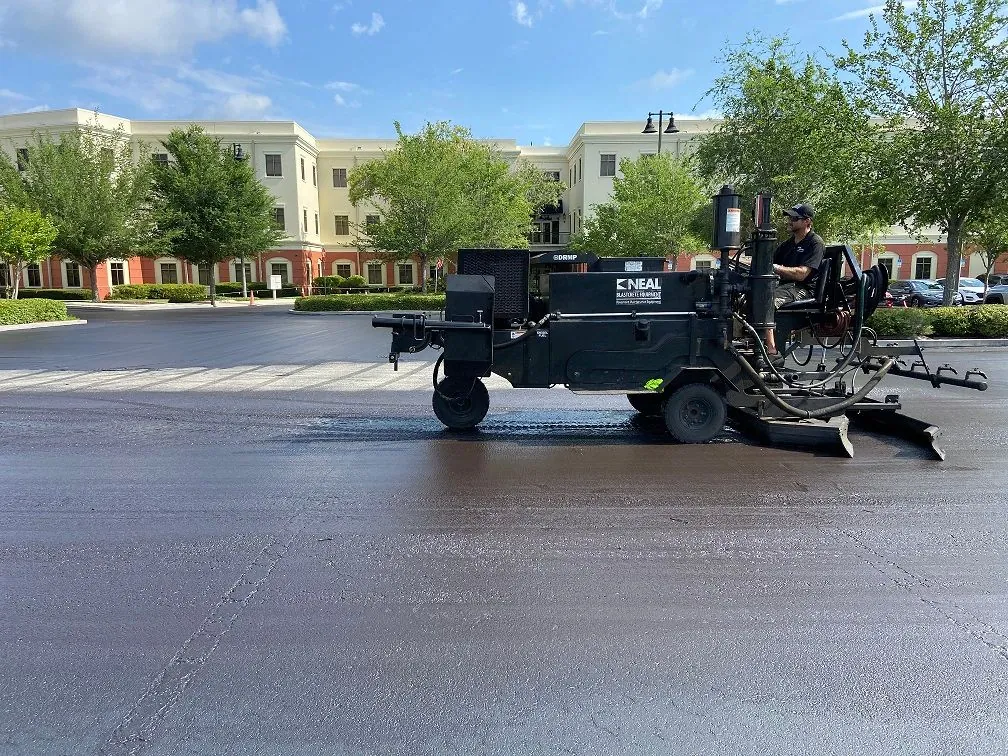
We apply two coats of sealer. We typically apply the first coat by squeegee to force the material into the pores of the asphalt, and the second coat by spray to leave a smooth, uniform finish. This ensures maximum coverage and protection [2].
We recently helped a customer in Lake Nona whose driveway looked like it was 30 years old, despite the house being built in 2005. The harsh sun had turned the asphalt nearly white, and the HOA was sending violation notices. The homeowner was convinced they needed a full replacement.
After our assessment, we realized the structure was sound; it was just severely oxidized. We performed a deep clean, filled about 40 linear feet of cracks, and applied two coats of sand-reinforced sealer. The driveway looked brand new for a fraction of the replacement cost. The homeowner saved roughly $4,500 and satisfied the HOA immediately.
In College Park, we treat many driveways damaged by tree roots. While sealcoating can't stop a root from lifting the pavement, sealing the surrounding cracks prevents water from settling around the root, which slows down the upheaval. We've managed to extend the life of these historic driveways by years using strategic maintenance.
Sealcoating itself is a surface layer—it's not a filler. It will fill hairline cracks (the width of a hair), but anything larger requires separate crack repair materials. At Florida Sealcoating, we use hot rubberized filler for larger cracks before we seal. If someone tells you the sealer alone will fill wide cracks, they aren't being honest.
In Florida's heat, the drying time is faster than in northern states, but we still require you to keep vehicles off the surface for 24 to 48 hours. You can walk on it sooner, usually within 2 to 4 hours. We recommend turning off your sprinkler system during this time to prevent water spots.
It depends on the material. Older sealers were coal-tar based, which had high VOCs and a strong odor. We use asphalt emulsion sealers that are eco-friendly, low-odor, and safe for your family and pets. They don't burn skin like coal tar and they don't release harmful chemicals into the runoff water.
This is normal for the first few weeks, especially in 90-degree heat. The fresh sealer is thermoplastic, meaning it softens slightly when hot. If you turn your steering wheel while the car is stopped (power steering turns), it can scuff the surface. These scuffs usually blend in over time. We add silica sand to our mix to minimize this issue.
Don't let the Orlando sun turn your driveway into a crumbling liability. Sealcoating is the smartest, most cost-effective maintenance you can perform on your property. It boosts curb appeal, satisfies HOA requirements, and protects the foundation of your pavement.
At Florida Sealcoating, we treat every home like it's our own. We use the best materials, the right equipment, and we stand behind our work.
Need an estimate? Call us today at (407) 942-3681 to schedule your free driveway evaluation.
[1] “Water Sensitivity of Asphalt Pavements.”
[2] Pavement Coatings Technology Council. “Sealcoating Benefits and Best Practices.”
Get a free, no-obligation estimate for your asphalt project. Our team is ready to help protect and enhance your property.
(407) 942-3681