Asphalt graying is a common sight in commercial lots across Seminole County. In Sanford, the sun beats down on parking lots year-round, and that intense UV exposure accelerates oxidation faster than you might think. Florida Sealcoating in Sandford, FL, sees this damage daily, from the busy plazas on French Avenue to office parks near the Orlando Sanford International Airport. If you manage a property here, sticking to a three-year maintenance schedule isn't just a suggestion. It's the only way to stop your pavement from failing.
In Sanford, oxidation occurs when UV rays break down the asphalt binder, turning pavement from black to gray and making it brittle. This process speeds up significantly due to our 90°F+ temperatures and intense sun exposure. Once the binder weakens, aggregates loosen, leading to cracks and potholes. You'll see this damage happen roughly 40% faster here than in northern states.
It works like this. Asphalt concrete is a mixture of stone (aggregate) and a glue-like binder (bitumen). When that binder is fresh, it’s flexible and black. But oxygen and sunlight attack the chemical bonds in the bitumen. As the oils dry out, the surface loses its ability to hold the stones together.
We typically notice the first signs of this deterioration within 12 to 18 months of new paving in Central Florida. The deep black color fades to a charcoal gray. While this might look like a cosmetic issue, it’s actually a structural warning. The top layer is becoming brittle. When a heavy delivery truck turns its wheels on oxidized asphalt, the surface creates micro-cracks. Water from our frequent afternoon storms seeps into those cracks, eroding the sandy soil base underneath.
Oxidation is the enemy of longevity. By applying a protective layer, you shield the binder from the sun. Think of it like sunscreen for your parking lot. Without it, the "skin" of your parking lot burns, peels, and eventually cracks open.
For most commercial properties in Florida, sealcoat every 2-3 years to prevent irreversible oxidation damage. High-traffic lots, like those near Seminole Towne Center, may need attention every 24 months. Waiting longer than three years usually results in structural failures requiring expensive overlay or repaving work rather than simple maintenance.
Why is three years the magic number? It comes down to the wear cycle of the sealer itself. Quality sealer is designed to sacrifice itself to protect the asphalt underneath. Over roughly 36 months, tire traffic wears that protective coating away.
In our years serving Central Florida, we’ve found that managers who push this cycle to five years often face double the repair costs. By year four, the asphalt is exposed again. Oxidation resumes immediately. By year five, you aren't just looking at sealcoating. You're looking at extensive hot rubber crack filling and likely some full-depth patching where alligator cracking has started.
Signs you need sealcoating in Sanford, Florida right now:
Sealcoating in Sanford typically costs between $0.15 and $0.25 per square foot, depending on lot size and condition. A standard 10,000 sq ft lot might run $1,500 to $2,500. This is significantly cheaper than repaving, which often costs $2.00 to $4.00 per square foot. Factors like cleaning time, striping, and crack filling affect the final price.
Let's break down where your budget goes. The base price usually covers cleaning and the application of two coats of sealer. If your lot has been neglected, we have to spend more time prepping.
Oil spots are a major factor. If cars have been leaking oil in your parking stalls, we can't just seal over it. We have to treat those spots with a primer so the sealer sticks. If we don't, the sealer will peel off that oil spot within weeks.
Crack filling is another variable. We charge separately for hot rubber crack filling because the amount needed varies wildly from lot to lot. One property might have 100 linear feet of cracks, while another has 2,000. Expect to pay roughly $0.75 to $1.00 per linear foot for proper hot rubber crack filling.
Even with these add-ons, the math is simple. Spending $2,000 every three years is much easier on your cash flow than spending $40,000 to repave the lot after 18 years of neglect. That's a savings of nearly 50% over the life of the pavement [1].
Yes, traffic volume directly dictates your maintenance schedule because friction wears down the sealant layer. A busy plaza on French Avenue or 17-92 sees thousands of tires daily, stripping protection within 24 months. Lower-traffic office parks might stretch to 36 months. We inspect wear patterns in drive lanes to determine the exact timing for re-application.
Not all traffic is created equal. A sedan rolling through an apartment complex does very little damage. A garbage truck making a three-point turn in a tight dumpster enclosure does massive damage.
The "shear force" of heavy tires turning while stopped acts like sandpaper on your lot. We often see sealcoating wear off in turns and entrances within 18 months, while the parking stalls themselves look brand new.
For our clients with high-traffic properties, we sometimes recommend a "hybrid" maintenance plan. We might come out after two years to apply a single coat just to the main drive lanes, and then do the full lot on year three or four. This keeps the high-stress areas protected without the cost of a full mobilization every time.
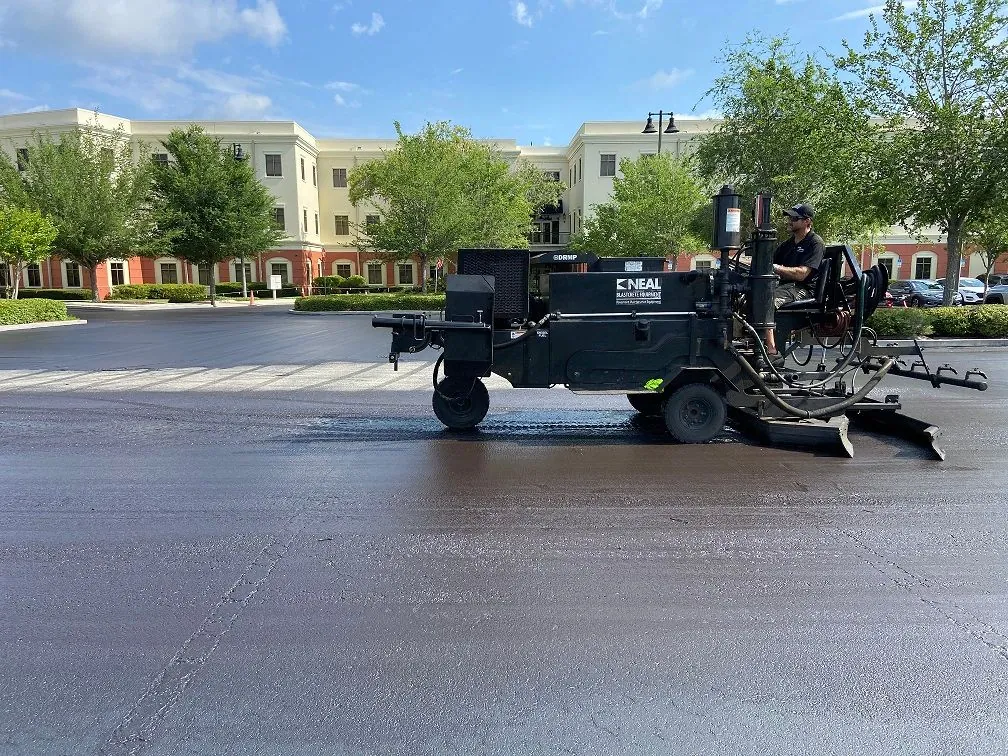
The commercial sealcoating process involves four key steps: rigorous cleaning, oil spot priming, hot crack filling, and the dual-coat application of sealer. We clean the surface using high-powered blowers and steel brooms to remove all dirt and debris. If we skip this step, the sealer adheres to the dirt, not the asphalt, and will flake off within six months.
1. Mobilization and Cleaning:
Our crew arrives and blocks off the designated section. We use stiff bristles and commercial blowers to get every grain of sand off the lot. In Sanford, we often deal with oak leaves and pine needles, which release acids that can stain pavement. We scrub these areas thoroughly.
2. Priming and Prep:
We treat petrochemical stains (oil/gas) with a latex-based primer. This creates a bridge between the oily asphalt and the water-based sealer. Without this, the bond fails.
3. Crack Sealing:
This is critical. We use hot-pour rubberized sealant heated to 400°F. We inject this into cracks that are 1/4 inch or wider. This rubber expands and contracts with the pavement during Florida’s temperature swings, keeping water out of the base.
4. Application:
We apply the sealer. For most commercial jobs, we use a spray application for an even finish, or a squeegee application for rougher pavement that needs the sealer forced into the voids. We always apply two coats. The first coat seals the voids; the second coat provides the wear layer.
5. Striping:
Once dry, we re-stripe your lines to DOT or local fire code standards. Fresh, crisp lines make a huge difference in curb appeal.
Curb appeal matters because the parking lot is the first thing a potential tenant or customer sees. A dark, black, freshly striped lot signals that the building is well-managed and safe. In contrast, a gray, cracked lot with faded lines suggests deferred maintenance and can lower property value by up to 5%. It creates a negative first impression before they even walk through the door.
In a competitive leasing market like Sanford, perception is reality. If you're leasing retail space, a well-maintained exterior tells national brands that you care about the facility.
Safety is part of curb appeal too. Faded lines cause confusion. If visitors can't see the crosswalks or the stop bars, accident liability increases. Fresh sealcoating in Sanford, Florida makes those yellow and white lines pop, guiding traffic safely.
Furthermore, sealcoating provides a uniform texture. As asphalt ages, the aggregate becomes polished and slippery when wet. Our sealer includes silica sand, which restores traction. This is vital during our summer rainy season when slick asphalt can lead to slip-and-fall claims [2].
The best time to sealcoat in Central Florida is during our drier months, typically October through May. We need 24 hours of dry weather for the sealer to cure properly. While we can work in summer, the daily afternoon thunderstorms in Sanford make scheduling difficult and risk washing away fresh sealer before it sets.
Summer in Sanford presents a unique challenge: humidity. Even if it doesn't rain, high humidity slows down the evaporation of water from the emulsion. If the water doesn't evaporate, the sealer doesn't cure hard.
However, we understand that schools and some businesses prefer summer work when traffic is lower. If we must work in July or August, we track the radar meticulously. We start at sunrise to ensure the sealer has had several hours of direct sun before the 3:00 PM storm clouds roll in.
We also have to manage irrigation systems. We can't tell you how many times a sprinkler system has popped on at 2:00 AM and washed away a fresh job. We require all irrigation to be turned off for 24 hours before and after the project.
Sanford managers choose us because we understand local challenges like sandy soil drainage and high UV index. We use commercial-grade emulsion sealers with sand loads tailored for traction in our wet climate. Our team coordinates with your tenants to minimize disruption, often working nights or weekends to keep your business running smoothly.
We aren't just guys with a bucket and a truck. We have the equipment to handle 50,000+ square foot distribution centers and the finesse to handle small medical offices off Lake Mary Blvd.
One major differentiator is our sand load. Manufacturers recommend 2 to 4 pounds of sand per gallon of sealer. Some contractors skimp on this to make the sealer spray easier. We don't. We load our sealer with the maximum amount of sand the spec allows. This ensures your lot isn't just black—it's tough and slip-resistant.
We also know the local codes. Orange County and Seminole County have specific requirements for handicap spacing and fire lane markings. When we restripe your lot after sealcoating, we ensure you're ADA compliant so you don't face fines during your next fire inspection.
Don't let the Sanford sun destroy your investment. If your asphalt is turning gray, it's already crying out for help. A proactive approach protects your budget and your liability.
Need Help With Your Sealcoating?
Contact Florida Sealcoating today for a free evaluation. We'll give you an honest assessment of your pavement's condition and a clear price to protect it.
[1] Asphalt Pavement Alliance - Pavement Value
[2] Pavement Friction for Road Safety
Get a free, no-obligation estimate for your asphalt project. Our team is ready to help protect and enhance your property.
(407) 942-3681