The 2026 ADA deadline is closer than most Florida commercial property owners realize. If your parking lot doesn't meet current ADA striping requirements, you're looking at fines starting at $75,000 for a first violation — and that's before any private lawsuits get filed. Contact Florida Sealcoating LLC today at (407) 942-3681 for a free compliance assessment before enforcement ramps up this year.
Parking lot striping isn't just paint on asphalt. It's a legal requirement that directly affects your customers, your liability, and your business's reputation as a welcoming place in your community. Here's what you need to know.
Florida's ADA striping requirements go beyond the federal baseline, and that gap catches a lot of property owners off guard. Under the Americans with Disabilities Act and the Florida Accessibility Code (FAC), commercial parking lots must meet specific standards for stall dimensions, color contrast, signage placement, and accessible route continuity.
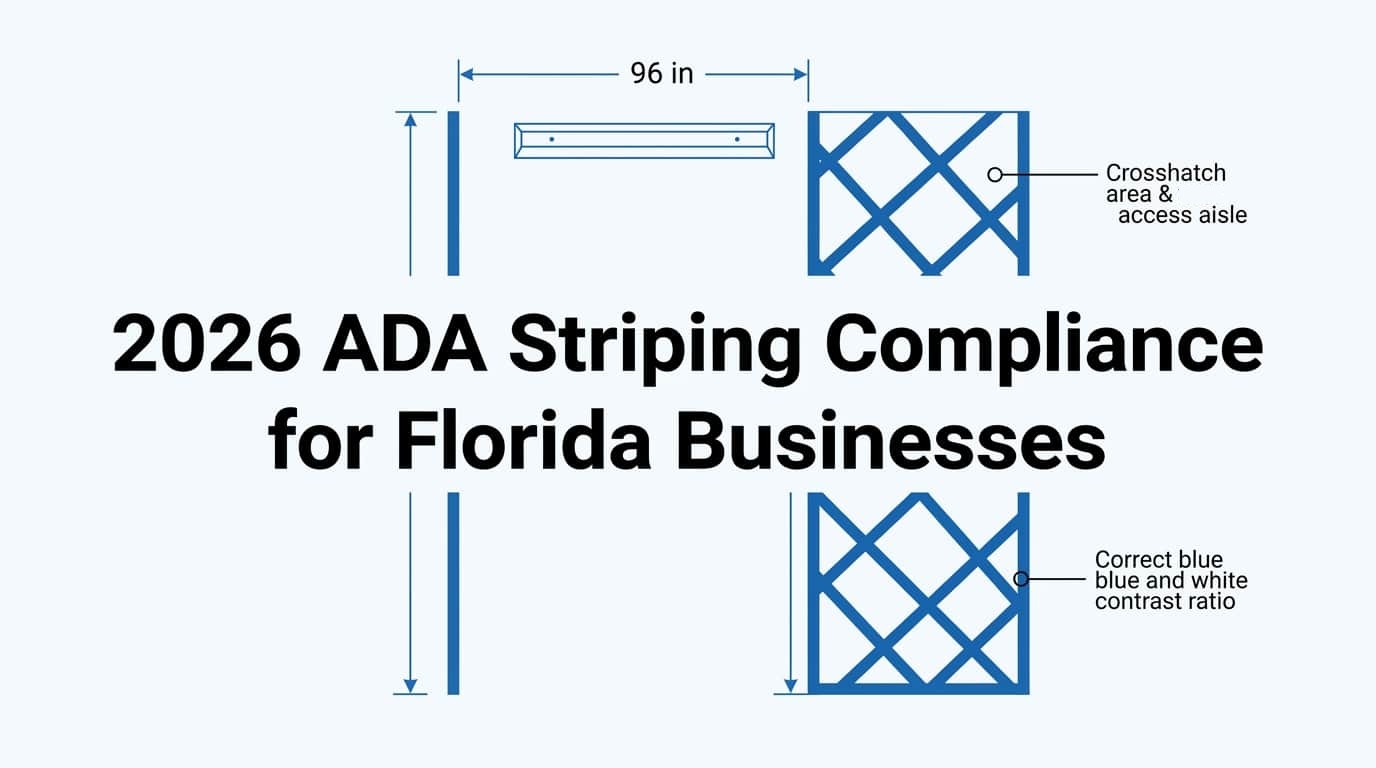
Federal ADA standards set the floor. Florida law often raises it. For example, Florida requires accessible parking spaces to measure at least 12 feet wide for standard accessible stalls, with an adjacent 5-foot access aisle. Van-accessible stalls must be at least 11 feet wide with a minimum 8-foot-wide access aisle — or 16 feet wide with a 5-foot aisle. That's a specific, measurable requirement, and most municipal inspectors in Volusia and Flagler Counties are checking for it.
Here's why this matters: even if your lot was compliant five years ago, resurfacing, fading, or re-striping done without proper specs can put you out of compliance today.
The required number of accessible parking spaces depends on your total lot size, and the math is stricter than most owners assume.
At least one in every six accessible spaces must be van-accessible. That ratio applies across your entire property, not just per lot section. Properties near high-traffic areas like the LPGA Boulevard corridor in Daytona Beach or the beachside retail zones along Atlantic Avenue are subject to the same counts regardless of how busy the location gets.
ADA-compliant accessible parking markings follow a strict visual standard. Here's what inspectors look for in Florida lots in 2026:
One thing our crews see frequently when we're doing sealcoating Daytona Beach Florida jobs: faded ISA symbols that were simply covered over by sealcoat without being re-stenciled afterward. That's an automatic compliance failure. Any time you have sealcoating done, accessible markings must be re-applied on top with fresh, clearly visible paint.
An accessible route is the continuous, obstruction-free path connecting accessible parking spaces to your building entrance. Getting this wrong is one of the most common — and most cited — violations in Florida commercial lots.
A compliant accessible route must be:
For properties near older commercial strips — think the US-1 corridor through Port Orange or the historic downtown blocks of DeLand — accessible route compliance often requires asphalt paving work, not just re-striping. Cracked or uneven surfaces that create tripping hazards don't just violate ADA; they're a premises liability waiting to happen.
Enforcement has tightened considerably this year, and commercial properties are the primary targets. Here's what's changed:
Florida municipalities are now cross-referencing business license renewals with property compliance records in several counties. Volusia County, which covers Daytona Beach and surrounding areas, has increased inspection frequency for commercial lots over 50 spaces. Local municipalities can also refer non-compliant properties to the Florida Commission on Human Relations, which operates independently of federal ADA enforcement.
Private lawsuits are a separate and significant risk. Florida is one of the most active states for ADA serial litigation. A single non-compliant van-accessible stall has been the basis for settlements averaging $15,000 to $25,000 in attorney's fees alone, even when the property owner corrects the issue quickly.
The enforcement environment isn't slowing down. Getting ahead of an inspection costs a fraction of what a violation will.
Here's a direct comparison that puts the numbers in perspective.
Cost of violations:
Cost of professional re-striping:
The math isn't close. Proactive re-striping — especially when bundled with sealcoating to protect and extend your pavement — is one of the lowest-cost risk management steps a commercial property owner can take.
Our team at Florida Sealcoating LLC has worked with commercial properties from beachside retail centers in New Smyrna Beach to shopping plazas near the Daytona International Speedway. In our experience, the properties that get cited are usually the ones that put off re-striping for "one more season." Don't let faded lines and outdated stall widths become an expensive lesson.
Getting your lot ready doesn't have to be complicated. Here's the process we walk our clients through:
Step 1: Conduct a stall count and measure your dimensions
Count your total spaces, then verify each accessible stall meets Florida's 12-foot minimum width. Measure your van-accessible stall separately for the 11-foot/8-foot aisle combination.
Step 2: Check your ISA markings and signage
Look for faded symbols, missing "Van Accessible" designations, and sign heights below 60 inches. If you've had sealcoating Daytona Beach Florida work done in the past 2–3 years without re-stenciling, this is likely where your gaps are.
Step 3: Walk your accessible route
Start at the accessible stall and walk to your main entrance. Measure the path width at its narrowest point. Look for cracked or lifted pavement that exceeds 1/2 inch in level change. Note any areas where the route crosses a driving lane without clear markings.
Step 4: Review your slope
A 2% bubble level is a quick field check for cross slope. Anything that feels noticeably tilted probably exceeds the 1:48 limit.
Step 5: Schedule a professional assessment and re-striping
A professional crew can measure, document, and re-stripe your lot to ADA specifications in a single visit for most standard commercial properties. When you pair the striping work with asphalt paving repairs or sealcoating, you save on mobilization costs and get everything done before an inspection window opens.
Non-compliance gets more expensive the longer it sits. A $500 re-striping job today is a straightforward line item. A $75,000 federal fine or a five-figure legal settlement is a crisis.
Florida Sealcoating LLC has served commercial property owners across Central Florida and the Volusia County coast for over 20 years. Our crews handle ADA-compliant parking lot striping, full lot sealcoating, and asphalt repair — all in one visit when possible. Call us at (407) 942-3681 to schedule your free on-site assessment and get your lot ready for 2026 inspections.
Get a free, no-obligation estimate for your asphalt project. Our team is ready to help protect and enhance your property.
(407) 942-3681