Before a Sanford HOA board signs a paving contract, it should get clear answers on four things: the contractor's references on similar community jobs, the exact scope and warranty in writing, how residents will be notified and kept moving, and what each bid actually includes beyond the total. Boards that ask these questions rarely end up disappointed with the result.
Paving shared roads and lots is usually one of the largest line items a community reserve pays for, and board members have to answer to their neighbors for it. At Florida Sealcoating LLC, we present to boards regularly and expect tough questions. If your community is getting bids now, contact our team at (407) 942-3681 to request a proposal.
Ask for references from community jobs like yours, not driveways or single storefronts, and then go look at them. A lot paved two or three years ago tells you far more than one finished last week.
HOA paving is its own kind of job. Private roads, cul de sacs, a clubhouse lot, mailbox kiosks, and a few hundred residents who all need to get in and out. Ask for three references from communities of similar size, with a contact name at the management company or board. Newer communities off the SR 46 and Rinehart Road corridor have plenty of recent paving, so you can often drive past real examples in town. Look at the seams, the edges along curbs, and whether water sits anywhere after rain.
Then check the basics. Confirm the contractor's Florida license on the DBPR website and ask for a certificate of insurance showing general liability, workers' compensation, and commercial auto coverage, with the association named as certificate holder. A contractor who hesitates to send any of that is telling you something. Ask, too, whether the crew on your job will be the contractor's own people or subcontractors.
Everything the board is paying for should be on paper: what gets removed, what gets rebuilt, how thick the new asphalt will be, and what happens if something fails. If it isn't written down, assume it isn't included.
A solid proposal spells out whether the job is a mill and overlay or full replacement, how much base repair is included and how extra base work will be priced if it turns up, the compacted thickness of the new asphalt, and how drainage at low spots will be corrected. It should also cover striping, accessible parking at the clubhouse, speed humps, and cleanup. Our Asphalt Paving proposals break this out area by area so the board can see what each section costs.
Read the warranty carefully. What does it cover, workmanship, materials, or both? For how long? What is excluded? Many warranties exclude base failure outside the areas that were rebuilt, which is fair, but the board should know that before signing. Also check your governing documents and Florida's HOA statute, Chapter 720, for any competitive bid requirements on large contracts, so the process holds up if an owner questions it later.
The contractor should hand the board a phasing plan and a notice schedule before work starts, and name one person residents can reach. Residents forgive a construction schedule. They don't forgive surprises.
Ask how the community will be split into phases and how long each street or lot will be closed. Fresh asphalt typically needs 24 to 48 hours before traffic, so residents on a closed street need a place to park and a way to reach their homes. In Sanford that often means planning around the morning commute onto Lake Mary Boulevard and I-4, trash pickup days, school bus stops, and deliveries. Cars left on the work area have to be moved, and the notice needs to say so plainly, with a date and a time.
We give boards a written notice they can send by email and post at the entrances, followed by reminders before each phase, and the schedule shifts for community events when needed. That kind of coordination is a big part of how we handle asphalt and sealcoating in Sanford for associations.
Line up the bids by what they include, not by the total. Two proposals that look thousands of dollars apart are often pricing two different jobs.
Put the bids side by side and compare base preparation, asphalt thickness, material spec, drainage fixes, striping, warranty length, and what is excluded. The cheapest number often skips base repair, lays thinner asphalt, or leaves drainage alone, and the board pays for that difference a few years later.
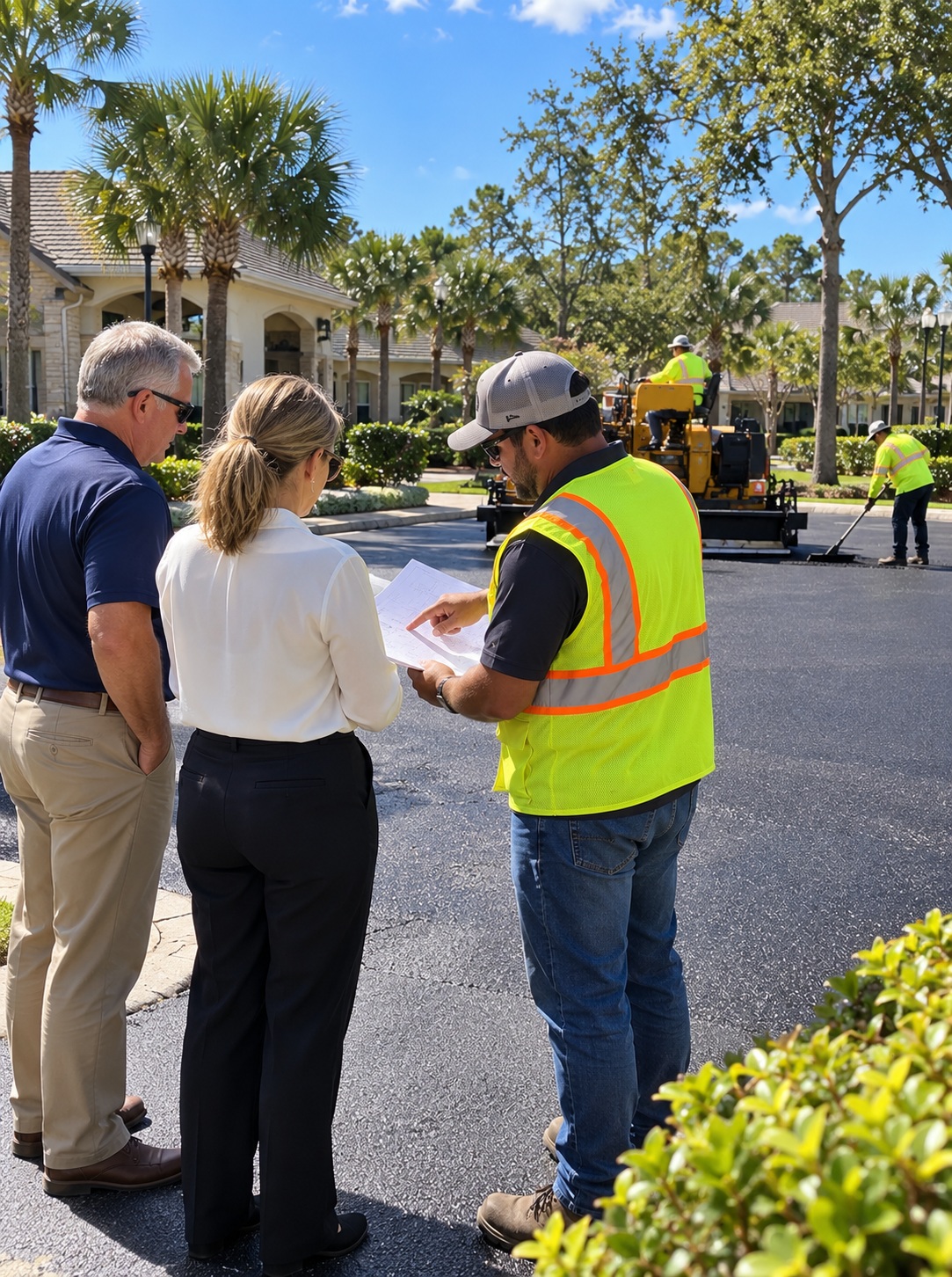
We've seen this firsthand. An HOA board in Sanford asked for our help after it received three paving estimates that varied wildly from each other. We talked through each bid with the board and helped them understand the differences so they could compare base preparation, materials, and warranty on equal terms. Once the scopes were lined up, the gap in price made sense, and the board could explain its choice to the residents.
If your board is weighing paving bids, call (407) 942-3681 or request a proposal from our team. We'll walk the community, answer the board's questions, and give you a proposal written so it's easy to compare.
Get a free, no-obligation estimate for your asphalt project. Our team is ready to help protect and enhance your property.
(407) 942-3681