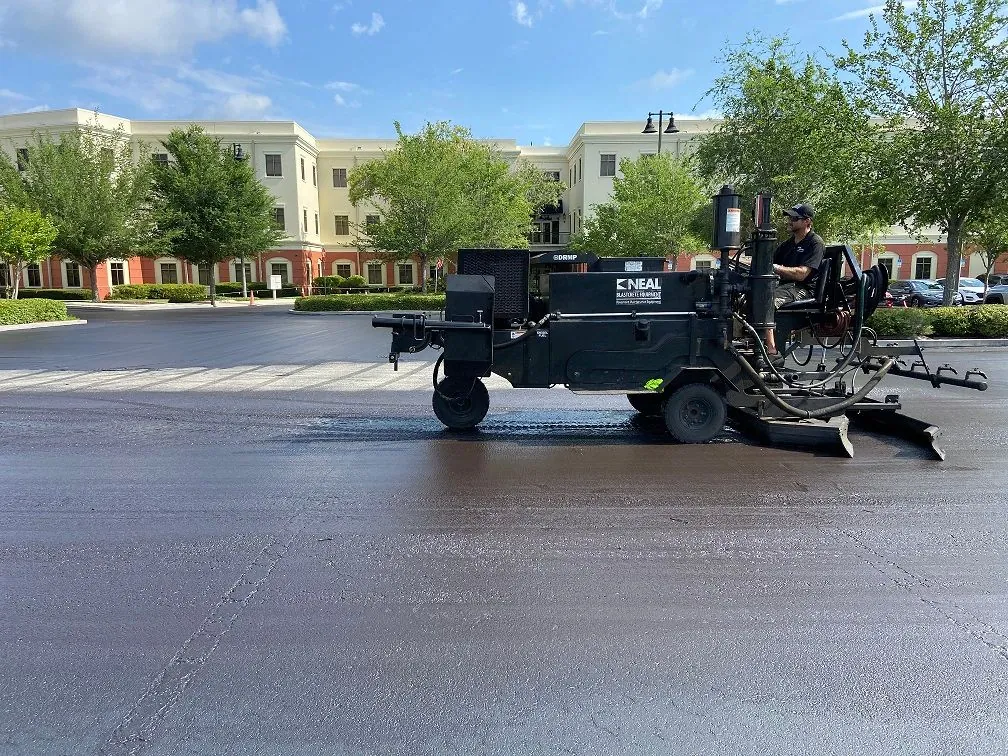
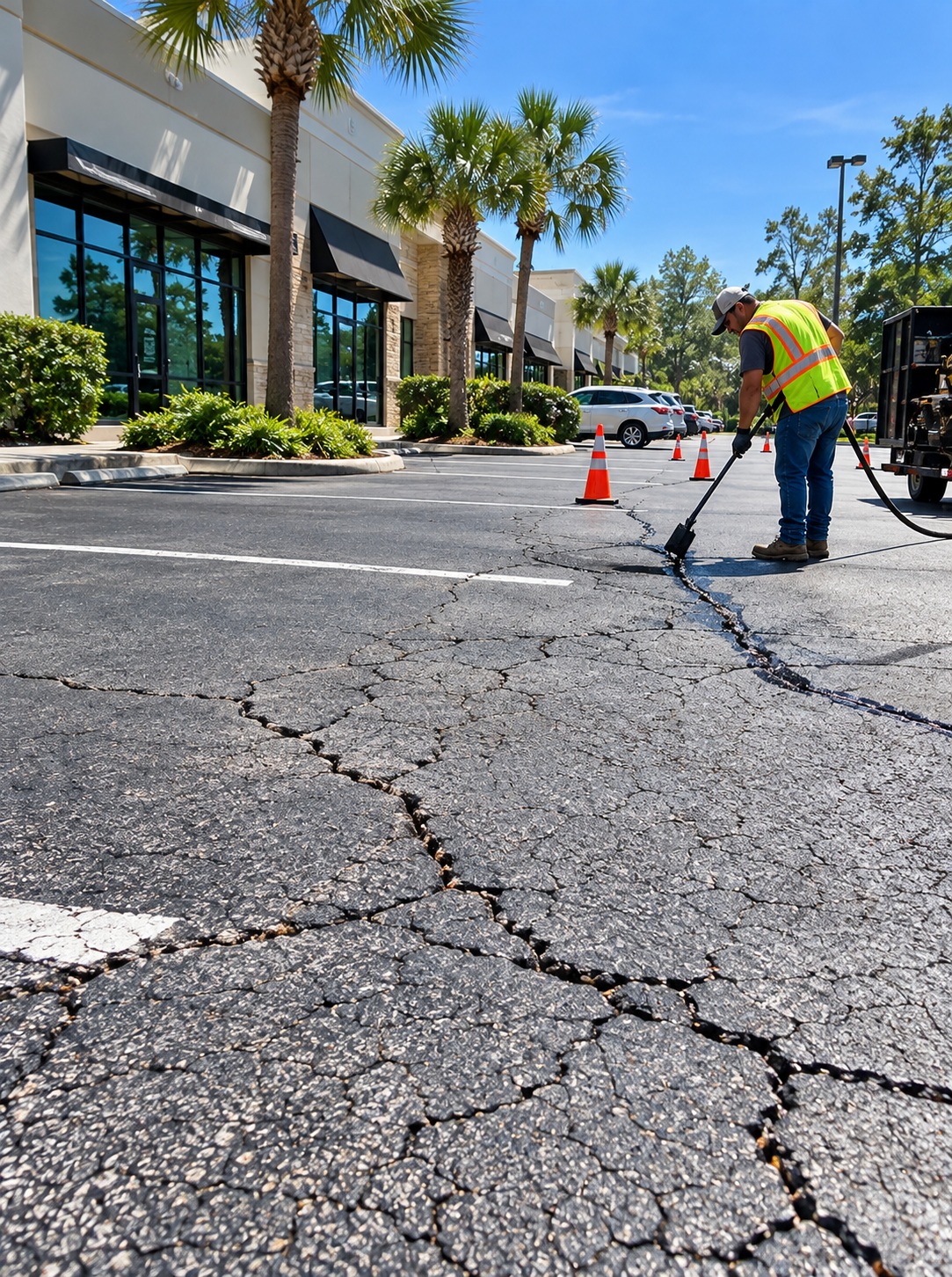
If the cracks in your Daytona Beach lot are isolated and the pavement around them is firm, targeted asphalt repairs will usually do the job. If the cracks have joined into a web, the surface is sinking, or the same potholes keep coming back, the base has failed and patching is just buying time. Most lots fall clearly on one side of that line once someone walks them.
At Florida Sealcoating LLC, we size up commercial lots across Volusia County every week, and we'll tell you straight which side yours is on. If the cracks are growing faster than your patience, get in touch with our team at (407) 942-3681 to set up a site assessment.
Look at the pattern, not the number of cracks. Straight, separate cracks are usually surface wear. Interlocking cracks that look like reptile skin mean the pavement is failing from below.
Single longitudinal cracks along a drive lane, or a crack running across the lot where two paving passes meet, are normal aging. Clean them out and seal them with hot pour rubberized filler, and they stop letting water in. Alligator cracking is different. That web of small connected blocks tells you the asphalt has lost its support and is flexing under every car. You can't seal your way out of it. On lots off International Speedway Boulevard that take delivery trucks and all day retail traffic, we usually see alligator cracking first in the truck path and at the entrances, where vehicles brake and turn.
Here is the quick rule we use. If alligator cracking covers a few defined spots, those sections get cut out and replaced while the rest of the lot gets asphalt repairs and sealing. If it covers most of the lot, a repave is the cheaper answer over the next ten years, even though it is the bigger check today.
Standing water, soft spots, and potholes that reopen in the same place are the giveaways. Once water gets under the asphalt and weakens the base, surface patches won't hold.
Daytona makes this worse than most places. Summer storms dump heavy rain in short bursts, and on low lying properties east of the Halifax River the ground stays wet longer. Water runs into open cracks, sits in the base rock, and softens it. Then every car that drives over it pumps a little more fine material out. You'll see it as bowl shaped depressions that hold puddles a day after the rain, edges that crumble near landscaping, and patches that sink or pop out within a season.
Try this after the next storm. Walk the lot the following morning and note where the water is still sitting. Then press a heel into the pavement near the worst cracks on a hot afternoon. If it feels spongy, or if a patch you paid for last year already has cracks around its edge, the problem is below the surface. At that point the fix is removing the failed section down to the base, rebuilding it, and paving it back, or repaving the whole lot if that pattern is everywhere.
Repairs cost a fraction of a repave, but only while the base is still sound. Once it isn't, repeat patching can end up costing more than paving would have.
Crack sealing and spot patching are priced by the linear foot and the patch, and on most commercial lots they run a small share of what new pavement costs. A full repave is a different scale. New asphalt paving on our projects generally runs about $3 to $5 per square foot, with base condition moving that number the most. That gap is why managers keep patching. It makes sense for a year or two. It stops making sense when you're paying for the same potholes along Beville Road or Nova Road every rainy season.
The middle option often gets overlooked. Replace the failed sections, mill and overlay the worn lanes, and seal the rest. On many lots that stretches the budget and buys years. We lay those options side by side for commercial clients who need asphalt and sealcoating in Daytona Beach, with each area of the lot priced separately so you can see where the money actually goes.
More than most managers expect. Broken edges, potholes, and uneven patches are trip hazards, and if a tenant or visitor gets hurt, the question will be how long you knew about it.
Heaved asphalt and potholes near entrances, crosswalks, and accessible stalls are the riskiest spots, because that is where people walk while looking at their phones or carrying things. Vehicle damage claims from deep potholes are common too. Tenants also notice. A rough, patched entrance tells every client who walks in that the property is not being kept up, and that comes up at lease renewal.
A property manager in Daytona Beach called us about patching a few cracks near the entrance of his building. Before we even got to the site, he called back. His tenants were joking that they needed crampons to get into the building, and he figured the area probably needed to be repaved. When tenants start making jokes like that, the lot has already been decided. What's left is fixing it before a joke turns into a claim.
If cracks are spreading across your lot, call (407) 942-3681 or book a site assessment with our team. We'll walk the pavement with you, show you exactly where repair still works and where it doesn't, and put it all in a written estimate.
Get a free, no-obligation estimate for your asphalt project. Our team is ready to help protect and enhance your property.
(407) 942-3681