
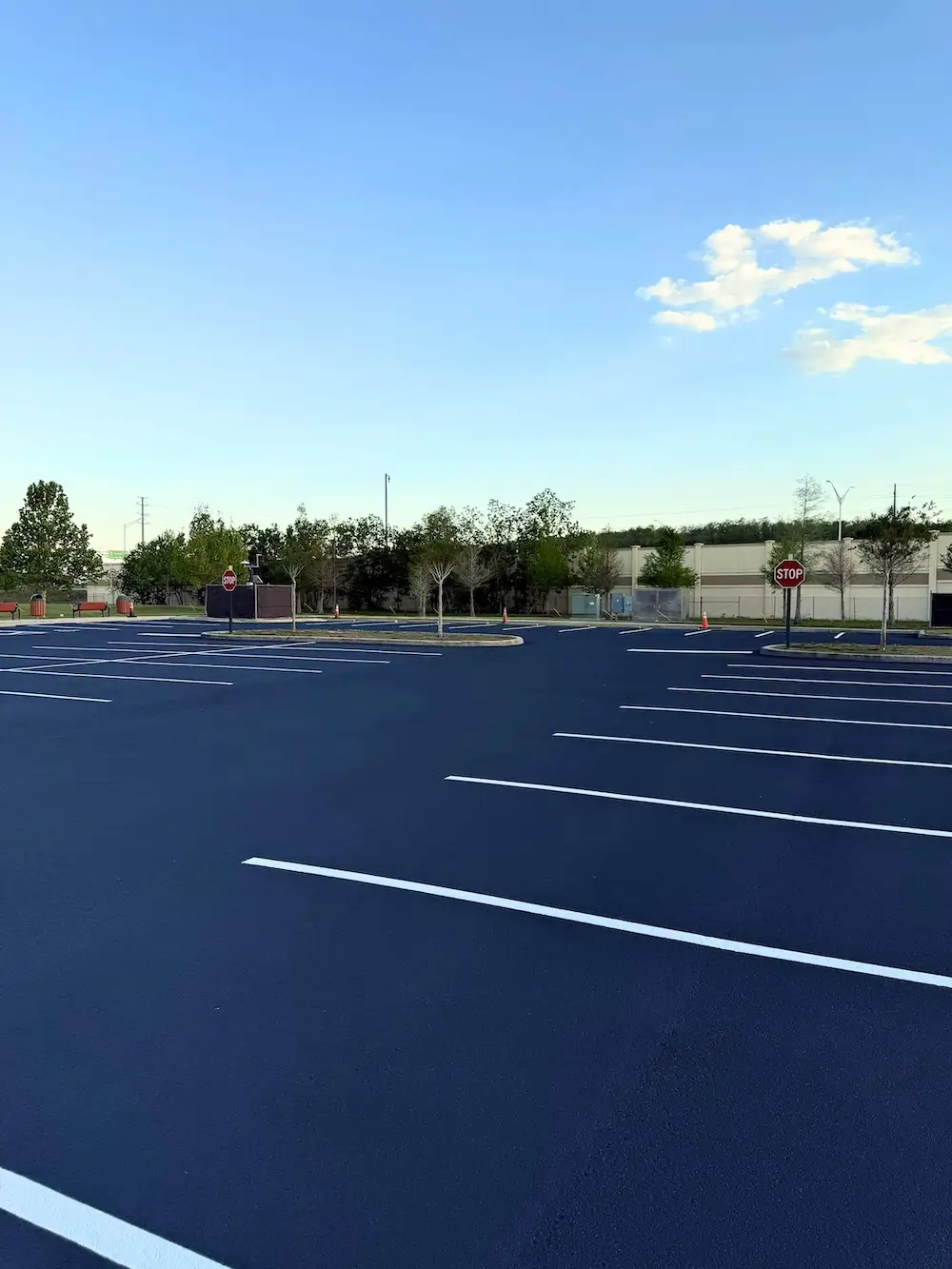
HOA Parking Lot Services in Central Florida
HOAs are actually harder to work than commercial parking lots. We plan for the irrigation schedules, the trash days, the residents on foot and bikes, and the resident who ignores the notice. 25 years of community work from Sanford to Palm Coast.
HOAs Are Actually Harder Than Commercial
Most contractors think an HOA parking lot is easier than a shopping center because the traffic volume is lower. In our experience it is the opposite. Commercial tenants have property managers you can email once and be done. HOA residents have to be reached individually, through mailbox notices and community boards, and every one of them has to actually read the notice, move the car, and stay off the fresh sealer.
Add in the irrigation and fertilization schedules the community landscaper is running, the trash and recycling truck days that cannot be rescheduled, and the residents on foot or bikes who assume a cone across a drive aisle does not apply to them. It is a lot of moving parts, and they are all people.
We have worked HOAs across Central Florida since 2000, from small townhome associations in Longwood to the 1,000,000 square foot Emerald Island vacation-rental community. Every one of them taught us something about how to keep a community open while we work.
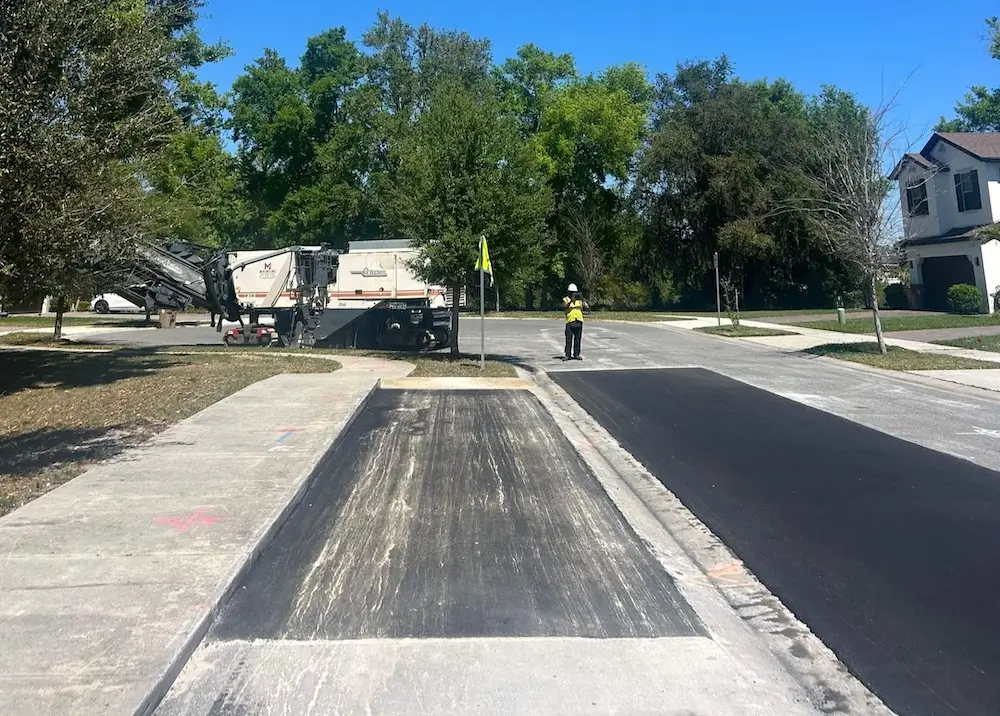
What HOA Board Members Actually Get
The board members and property managers who hire us are usually the ones who take the resident complaints personally. Here is what our HOA work is built to deliver so those complaints do not happen in the first place.
- Community-Specific Phase Map: Color-coded aerial drawing showing which section works on which day, delivered to the board and PM before day one so residents can see the plan before it starts
- Resident Communication Kit: Notices for every mailbox and building, plus signage for entrances so short-term guests and visitors see it too
- Tow Truck On-Site: During work hours we keep a tow truck on the property to move vehicles for residents who missed the notice, not away, just to the open side of the lot
- One-Day Buffer Between Phases: Residents get a full day between phases to move their vehicles instead of a few hours
- ADA and Accessibility Preserved: Accessible parking and building entrances stay reachable through every phase, and we restripe to current ADA specs as part of the finish
- Documentation for the Board: Certificates of insurance, W-9s, and specifications for board meetings and reserve-study conversations
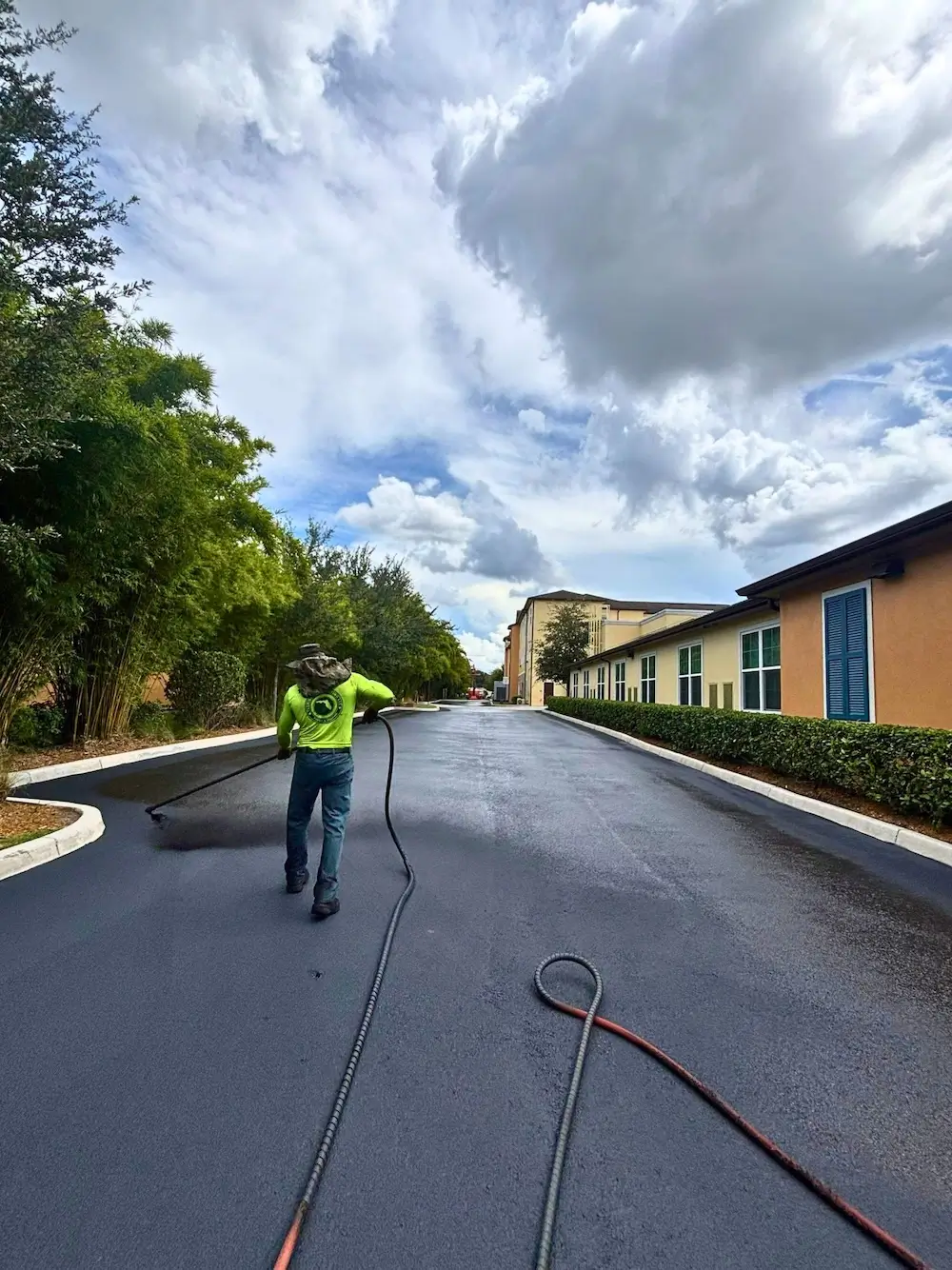
Why HOA Parking Lots Are Harder to Work Than Commercial
Four things make an HOA job different from a shopping center or medical campus. If your contractor has not planned for all four, they are going to miss deadlines and lose you goodwill with residents.
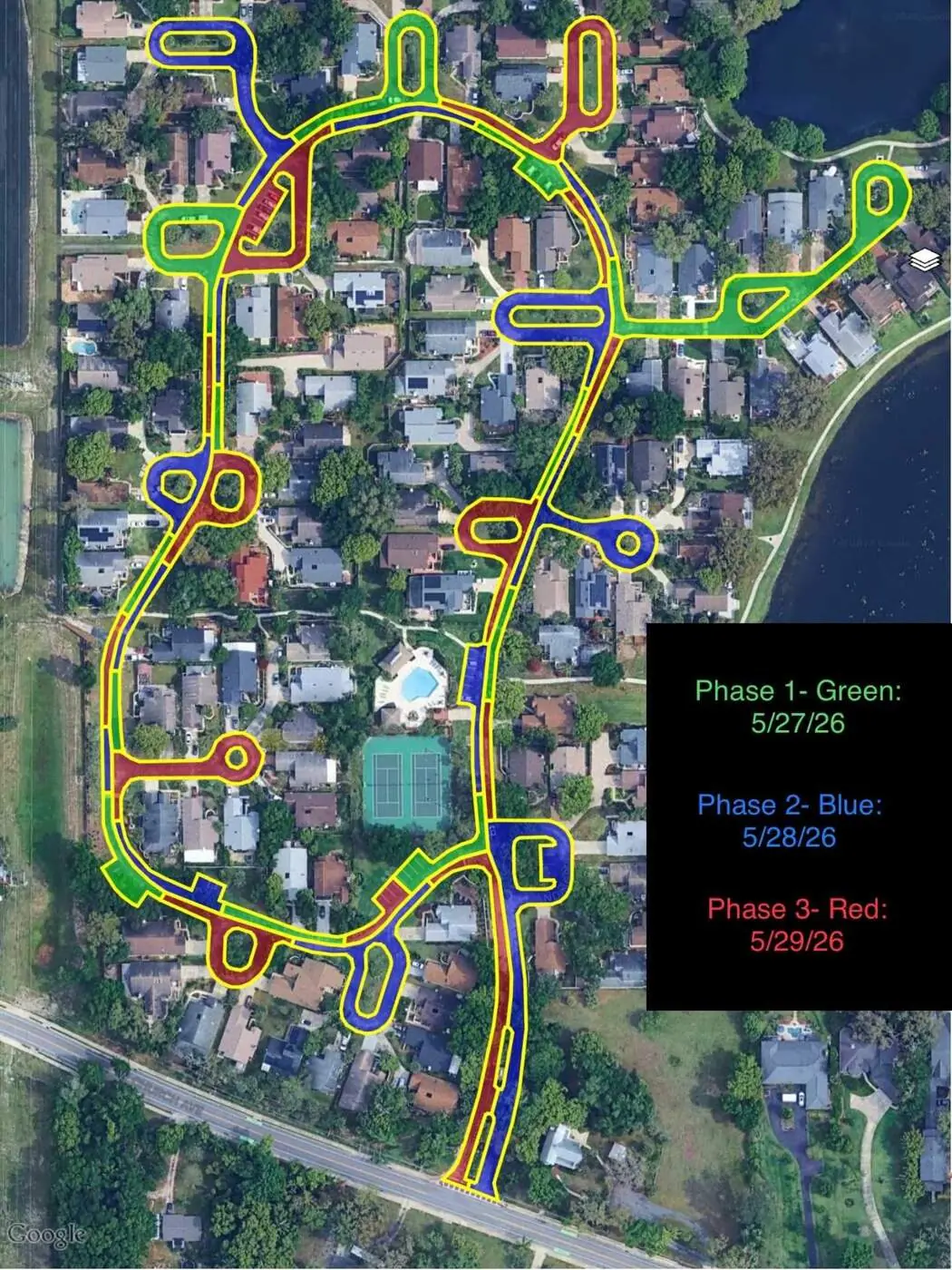
A real phase map from a Florida Sealcoating HOA job.
Before we schedule any work, we produce a color-coded aerial map of your community showing exactly which section we work on each day. Every road, entry, mailbox cluster, amenity, and dumpster location gets accounted for.
The map goes to the board, the property management company, and the on-site staff at least a week before we mobilize. It gets copied and posted on every mailbox and community bulletin board. If the community has short-term rentals, we send it to the booking companies too.
Then we build a full day of buffer between phases so residents have time to move their vehicles. And we keep a tow truck on-site during work hours to move cars for anyone who missed the notice.
The Four Things We Plan Around on Every HOA Job
1. Landscape & Irrigation Schedule
Sprinklers running the morning we sealcoat can ruin a phase. We coordinate with the community's landscaper before day one so irrigation and fertilization schedules for our work zones are moved to the other end of the schedule. Trims and mowing get bumped too if they conflict.
2. Trash & Recycling Days
The city or hauler cannot reschedule pickup. We schedule around it. Dumpster pads and pickup routes stay open on collection days, and if the schedule forces a conflict we phase the section immediately after pickup while the routes are empty.
3. Pedestrians, Bikes & Kids
Commercial lots have cars. HOAs have people, and they will walk right through wet sealer if the sidewalk stays open next to it. We block sidewalks that adjoin fresh work, mark alternate routes, and keep entrances to buildings and mailboxes reachable on foot the whole time.
4. Resident Vehicles & The Tow Truck
The hardest part of an HOA job is not the sealcoat. It is getting every resident to move their vehicle before the crew arrives. We give a full day of notice between phases and keep a tow truck on-site during work hours to move vehicles for owners who missed it, not to impound them, just to the open side of the lot.
"Have you ever worked in a community like this before? Please provide a reference for such."
The question every HOA board should ask a paving contractor. Most never do.
Request References From Communities Like YoursCommunity Types We Serve
Every community is different. Here are the ones we work most often in Central Florida, and what makes each one specific.
Single-Family HOAs
Master-planned neighborhoods with private roads, cul-de-sacs, and driveway aprons. Common in Sanford, Lake Mary, Longwood, and Oviedo. The work is usually the community roads plus HOA-owned amenity parking, not the private driveways themselves.
Townhome & Villa Communities
Attached-home communities where the HOA owns the parking areas and interior roads. Denser than single-family and more vehicle-management complexity because there are fewer parking spaces per unit.
Condominium Complexes
High-density lots with covered parking, guest spaces, and often assigned stalls. The challenge is coordinating with owners who may live out of state and only visit seasonally, plus renters who never see the mailbox notices.
Vacation Rental Communities
Emerald Island, Windsor Hills, Reunion, and other Disney-corridor communities where units turn over weekly. The booking company has to be a partner, not just the HOA board. Multilingual signage and extra schedule buffer are baseline.
Gated & 55-Plus Communities
Access-controlled communities with amenity centers, private streets, and higher pedestrian traffic. In 55-plus communities the accessibility considerations are non-negotiable and every route has to accommodate mobility devices during phasing.
Apartment & Multifamily
Complexes where the property management company (not an HOA board) makes decisions. Faster approvals, but the tow truck on-site is even more important because renters move often and notices get missed constantly.
HOA Asphalt Services We Provide
One vendor for everything an HOA parking area, community road, or amenity lot needs. That way there is one certificate of insurance, one point of contact, and one company accountable for the finished result.
Maintenance
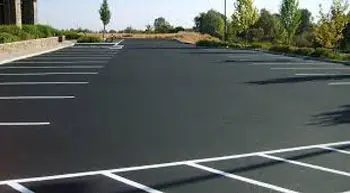
- Sealcoating: The 3-year cycle that keeps community roads and lots from oxidizing and cracking
- Crack Sealing: Hot rubberized fill so summer rain does not get into the base
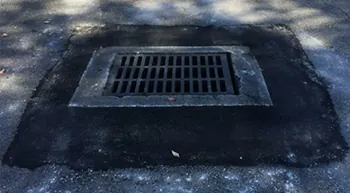
- Pothole & Patch Repair: Targeted fixes to failing spots before they force a full rebuild
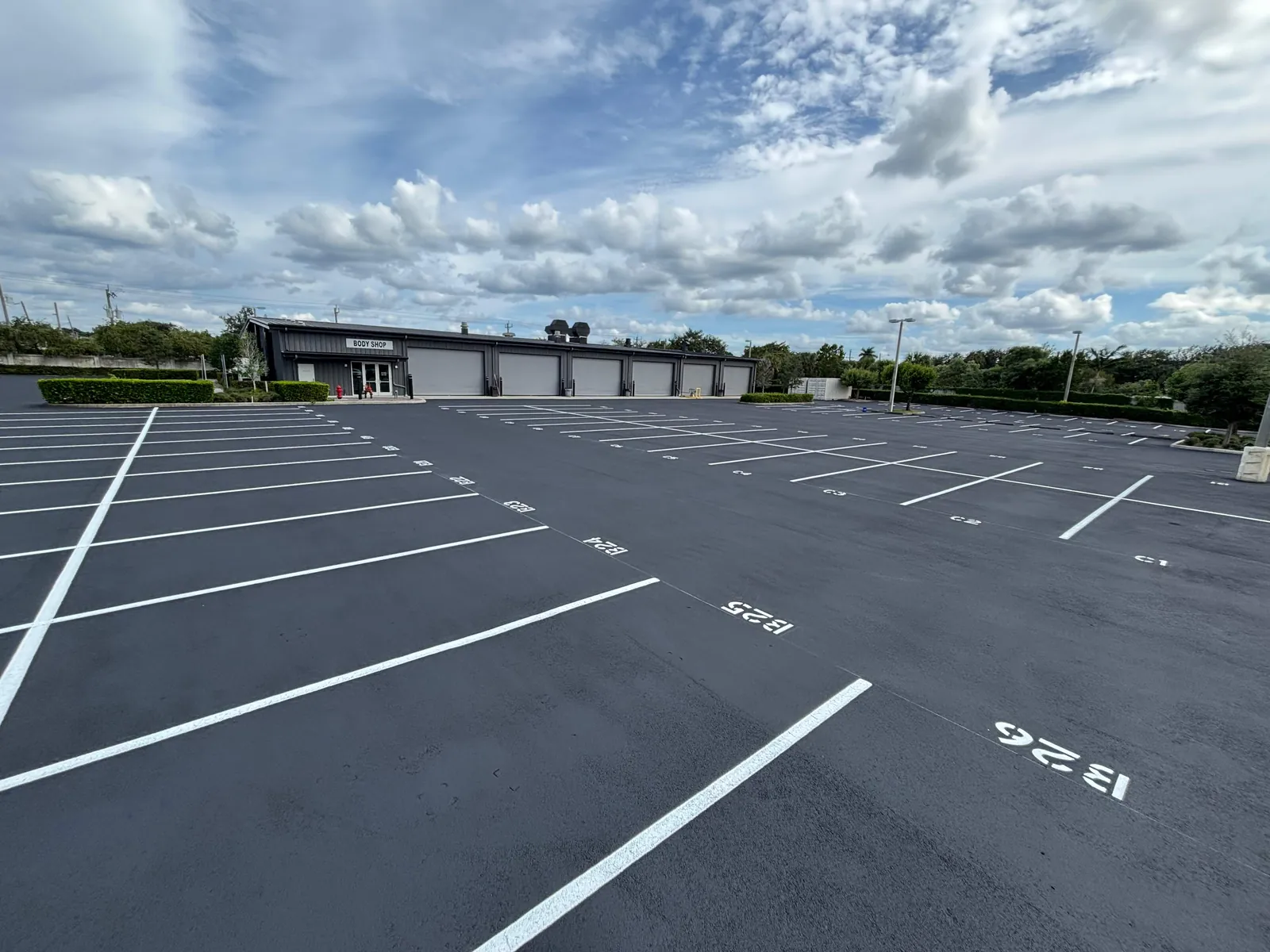
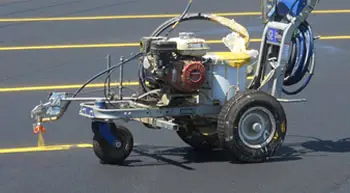
- Restriping: Parking stalls, ADA spaces, community road markings
Paving & Reconstruction
- Mill-and-Overlay: Fresh surface course when the base is still solid
- Full Reconstruction: When the base has failed and no overlay will hold
- New Amenity Lots: Pool decks, clubhouses, pickleball, tennis, dog parks
- Community Road Repair: Long roads phased so residents keep access to their homes
Signage & Traffic Control
- Stop Signs & Speed Limit Signs: Installed to community spec, MUTCD compliant
- ADA Signage: Handicap parking signs with proper mounting height
- Speed Bumps & Speed Tables: Rubber or asphalt for enforcement zones
- Directional Markings: Arrows, crosswalks, stop bars, and pedestrian markings
Board & PM Documentation
- Certificate of Insurance: Provided before mobilization, additional insured on request
- Material Specifications: Line-item spec sheets for board meeting review
- Reserve-Study Support: Multi-year maintenance plans that map to your reserve schedule
- Board Presentation: We come to the meeting if you want us to walk the plan with your residents
What HOA Boards Should Ask Any Contractor
Before signing a paving contract, the board should ask every bidder these five questions. Most contractors are used to being asked about price and timeline. Fewer are ready for these.
- Have you worked in a community like ours before? Ask for a reference in a community that matches yours (size, unit count, ownership type). Any contractor who has done real HOA work can name one.
- What does your phase map look like? Ask to see a real one from a comparable job. If they cannot show you one, they have not planned this out.
- Who is responsible for resident communication? The answer should be a partnership between the contractor and the board or PM, with clear ownership of who tells residents what and when.
- What happens when residents ignore the cones? A real answer includes the tow truck on-site, optional security, and setting board expectations upfront. A weak answer blames the residents.
- What is your CGC license number and can we see current COI? Both should be provided before contract signing, not after mobilization.
- How do you handle irrigation and trash days? If the contractor has not coordinated with your landscaper and hauler on prior HOA jobs, expect surprises on this one.
HOA Parking Lot FAQs
How much does HOA parking lot sealcoating or repaving cost?
How do you handle resident notification for our community?
What happens when a resident ignores the notice and drives on wet sealer?
How long will community roads and lots be closed during the work?
Do you present at HOA board meetings?
How does this work fit into our reserve study?
Are you licensed, insured, and willing to be added as additional insured?
Can we do repairs now and defer the full repave to next year?
We serve HOA and community properties throughout Orlando, Sanford, Kissimmee, Daytona Beach, and the rest of Central Florida. Contact us to schedule a walk-through of your community.
Our Services
Ready to Get a Plan For Your HOA Property?
We come to the property, walk it with you or the property manager, and put a real phase map and budget in front of your board. Free estimate, licensed and insured, and a reference from a community that looks like yours if you want one.
(407) 942-3681